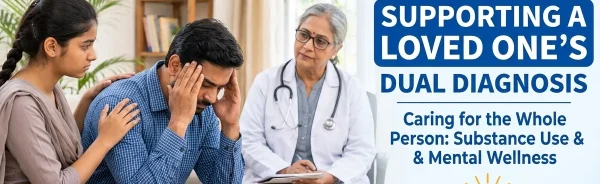
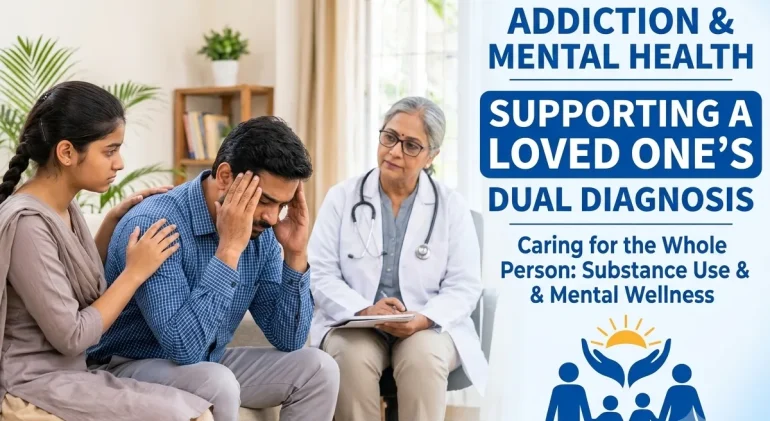
Dual diagnosis treatment in Chennai means getting care for addiction and a mental health condition, such as depression or anxiety, as one joined-up plan. Why does that matter? Because each problem keeps the other going. Treat only the drinking and untreated anxiety often pulls the person back. Treat only the mood and ongoing substance use undoes the progress.
This article offers general information and is not a diagnosis. Only a qualified clinician can assess mental health and substance use. If someone talks about harming themselves, call 112 or Tele-MANAS on 14416 right away.
Key takeaways
- In US survey data for 2024, about 8% of adults had both a mental illness and a substance use disorder; 41.2% of them got no treatment for either (Partnership to End Addiction summary of SAMHSA NSDUH).
- Only 14.5% of those adults received both kinds of treatment, which is why integrated care matters.
- Ask any centre how it assesses mental health at admission and who reviews medicines.
What is dual diagnosis?
“Dual diagnosis” is the everyday term for co-occurring disorders: a substance use disorder alongside a mental health condition, like depression, an anxiety disorder, bipolar disorder or PTSD. US survey figures show it’s far from rare. SAMHSA’s 2024 survey found 8% of adults had co-occurring disorders. It doesn’t mean the person is “more broken” than anyone else. It’s simply a reason to widen the assessment.
India’s own numbers show the scale of the underlying problems. The National Mental Health Survey (2015-16) found substance use disorders, including tobacco, in 22.4% of adults across 12 states, and nearly 15% of adults needing active help for a mental health issue.
Why do the two so often go together?
There’s no single cause, and it isn’t always clear which came first. Three patterns come up again and again. Self-medication: someone with constant anxiety finds alcohol quiets it for a few hours, then needs more. Substance use worsening a condition: heavy use can bring on anxiety, low mood and sleep problems. And shared risk factors, like stress, trauma and family history.
Picture a man in his thirties who began drinking in the evenings to switch off racing thoughts after a stressful job. Two years on he drinks nightly, sleeps badly and feels more anxious than ever. His family sees the drinking. The anxiety underneath rarely gets mentioned. (This is an illustration, not a real case.)
What signs might a family notice?
You can’t diagnose from outside, but some patterns suggest a combined assessment is worth asking for:
- Low mood, hopelessness or lost interest that continues in sober periods
- Panic, intense worry or social fear that the person calms with alcohol or drugs
- Big swings between very high energy and deep lows
- Days with little sleep, or sleeping most of the day
- Suspicion, hearing or seeing things others don’t, or confused thinking
- Repeated relapses despite sincere effort and good support
Any talk of self-harm needs immediate attention. Call 112, or Tele-MANAS (14416 or 1800-89-14416), which is free and open 24 hours.
Why does treating only one problem fail?
In the 2024 US survey, only 14.5% of adults with co-occurring disorders got both kinds of treatment, and 41.2% got none. Most who were treated received just one side. For years services worked separately: get sober first, mood later, or the reverse. People fell between the two.
Today the common recommendation is integrated care: one team, or closely coordinated teams, address both together. When anxiety is treated, alcohol’s pull often loosens. When drinking stops, mood becomes easier to read. Each makes the other easier.
What does integrated treatment include?
- A thorough assessment of substance use, mental health history, physical health and sleep.
- Safe detox first if needed. See our guide to the alcohol withdrawal timeline.
- Talking therapies, like CBT. Read What is CBT? and behavioural therapy for drug addiction.
- Medicines where appropriate, chosen and reviewed by a doctor.
- Family involvement, so the people at home understand the plan.
- Aftercare covering both mood and substance triggers. See relapse prevention strategies.
Are medicines safe to combine?
They can be, when the doctor knows everything the person takes and drinks, because some combinations are risky. Never start, stop or swap psychiatric medicines on your own, and don’t mix sedatives with alcohol. Our medication-assisted treatment safety guide lists the questions to ask.
What should you ask before choosing a centre?
- How is mental health assessed at admission, and by whom?
- If the person already takes psychiatric medicines, who reviews them?
- How do you handle a mental health crisis during the stay?
- Are therapy and counselling part of the plan, and how often?
- How is the family informed and involved?
- What does aftercare look like for both mood and substance use?
A specific answer to each beats a general promise of “complete care”. Our rehab admission guide lists what to prepare.
How can families help?
Share what you’ve noticed with the clinician. Families often hold the clearest picture of how the person was before, during and after heavy use. Bring a list of medicines, past diagnoses and any episodes of low mood or unusual behaviour. At home, aim for steady routines and a calm tone. “You’ve been struggling and I want to help you find support” lands far better than blame. Our guide to supporting vs enabling may help.
Frequently asked questions
Are these two separate illnesses?
Clinically, yes, two conditions. Because they influence each other, they work best treated together under one plan.
Can someone with depression or anxiety be treated at a rehab centre?
Many can, if the centre assesses mental health properly and has clinical oversight. Ask how it works before admission.
Which comes first, detox or mental health care?
With physical dependence, safe detox usually comes first, but mental health support should start alongside it. A clinician decides the order.
Does it take longer to treat?
It can, since there’s more to address. See how long treatment takes at a rehab centre in Chennai.
What if they say drinking is the only thing that helps?
That’s a very common experience and a good reason for assessment. It points to a problem that needs another kind of help.
Getting assessed in Chennai
If someone may be dealing with both addiction and a mental health condition, a first conversation is a sensible step. Contact Ayya Care Foundation on +91 90875 77780 to ask how assessment works. You can also read about our rehabilitation centre in Thiruverkadu. In an emergency, call 112 or Tele-MANAS on 14416.
Sources
- Partnership to End Addiction, 2024 national drug use survey insights (SAMHSA NSDUH), drugfree.org, retrieved 2026-11-13
- NIMHANS, National Mental Health Survey of India 2015-16 (summary), journalsofindia.com and PARI library, retrieved 2026-11-13