Behavioral Therapy for Drug Addiction: CBT, DBT, and What Actually Works
Table of Contents
Roughly 40% to 60% of people treated for a substance use disorder relapse at some point, a rate the National Institute on Drug Abuse says is comparable to relapse in diabetes and hypertension (NIDA). That statistic scares families. It shouldn’t. Addiction behaves like a chronic illness, and chronic illnesses respond to structured, ongoing treatment — not a single stint in rehab.
Behavioral therapy is the part of that treatment that changes how a person thinks, copes, and responds to triggers long after detox is over. Two approaches dominate the field: Cognitive Behavioral Therapy (CBT) and Dialectical Behavior Therapy (DBT). They overlap, but they’re built for different problems. This guide breaks down how each one works, what the evidence actually shows, and how they fit into a fuller treatment plan.
Key Takeaways
- CBT targets the thought patterns and triggers that drive drug-seeking behavior, and standalone CBT has been linked to roughly triple the odds of short-term stimulant abstinence versus minimal treatment (PMC meta-analysis, 2025).
- DBT was built for intense emotional dysregulation and is the stronger fit when addiction co-occurs with borderline personality disorder or chronic suicidality.
- Contingency management — a behavioral add-on that rewards verified abstinence — outperformed comparison treatments by 22% in one-year follow-up abstinence in a 2025 meta-analysis (CHCS).
- No single therapy “cures” addiction. The evidence points to combined models: behavioral therapy plus medical support, family involvement, and relapse-prevention planning.
- In India, only about 25% of people who need opioid dependence treatment actually seek it, and under 5% receive inpatient care (AIIMS/NDDTC, UNODC data) — access, not just method, is a real barrier.
What Does “Behavioral Therapy” Actually Mean in Addiction Treatment?
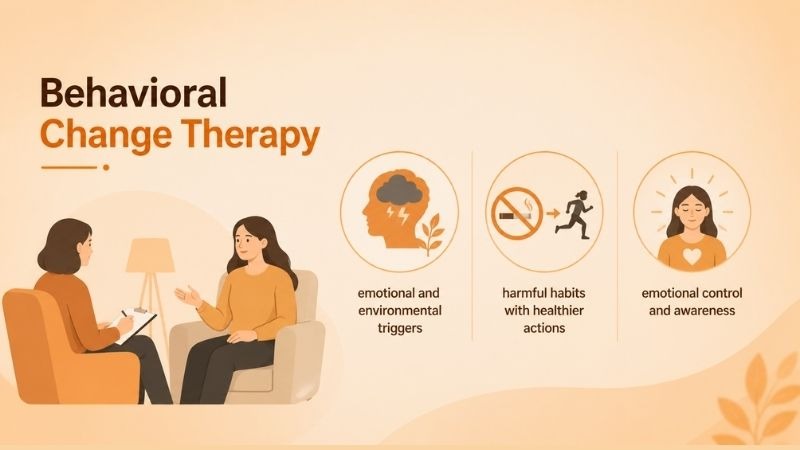
Behavioral therapy is talk therapy aimed at changing specific behaviors, not just insight or emotional processing. In addiction care, that means identifying the exact chain of events — a place, a feeling, a person — that leads to use, and building a different response to it.
It’s worth separating this from detox and medication. Detox manages withdrawal. Medication (where used) manages cravings or blocks the drug’s effect. Behavioral therapy is what addresses the decision-making around use — why someone reaches for a substance under stress, and what they do instead once the physical dependence is no longer driving things.
This matters because relapse isn’t usually about willpower failing in a vacuum. It’s usually a predictable response to an unaddressed trigger. That’s exactly the gap CBT and DBT are built to close.
How Does CBT Work for Addiction?
CBT for addiction runs on a simple premise: thoughts drive feelings, feelings drive urges, and urges drive use. Change the thought pattern early enough in that chain, and the urge loses its grip. A therapist and client map out specific high-risk situations, then practice alternative responses before they’re needed in real life.
A typical CBT course for substance use includes functional analysis (breaking down what happened right before a use episode), skills training for refusing offers and managing cravings, and homework between sessions to practice those skills in daily life.
The evidence is strongest for stimulant use disorders and moderate for cannabis. A 2025 systematic review found standalone CBT nearly tripled the odds of short-term stimulant abstinence compared to minimal-treatment controls, with an odds ratio of 2.88 across trials involving 849 participants, though the researchers rated the certainty of that evidence as low. For cannabis specifically, CBT was linked to a reduction of about 11 days of use and fewer dependence symptoms in a pooled analysis of nine randomized trials, though long-term effects were less consistent.
How Does DBT Work — and When Does It Beat CBT?
DBT started as a treatment for borderline personality disorder and chronic self-harm, then expanded into addiction because so many people with severe substance use also struggle with emotional dysregulation. Where CBT is mostly about restructuring thoughts, DBT adds a second track: distress tolerance and mindfulness skills for when the emotion itself is too intense to think through in the moment.
DBT for substance use has a specific concept worth explaining to families: “dialectical abstinence.” It combines a firm commitment to abstinence with full acceptance that a slip is part of the learning process, rather than treating a lapse as a moral failure that cancels out the whole recovery effort. That reframing reduces the shame spiral that often turns a single slip into a full relapse.
This matters most for a specific group. Nearly 78% of people diagnosed with borderline personality disorder also meet criteria for a substance use disorder, and this population tends to respond poorly to standard treatment alone. A controlled study of a 28-day intensive DBT program found significant improvements in coping skills and depressive symptoms in patients with co-occurring BPD and substance use, alongside the group without substance use. Separately, patients with co-occurring borderline personality disorder and substance use disorder who received DBT showed reduced substance misuse and lower dropout rates compared to standard care.
The honest caveat: a meta-analysis of six controlled studies found DBT groups outperformed comparison groups at post-treatment, but that advantage did not hold up as a statistically significant difference at longer-term follow-up assessments. DBT gets people stable faster; keeping gains over years still depends on continued support.
CBT vs. DBT for Addiction: Quick Comparison
| Factor | CBT | DBT |
|---|---|---|
| Core focus | Restructuring thoughts that trigger use | Regulating intense emotion + mindfulness |
| Best fit | Stimulant, alcohol, cannabis use disorders without severe co-occurring conditions | Substance use with borderline personality disorder, self-harm, or chronic emotional crisis |
| Format | Individual or group, structured sessions with homework | Individual therapy + weekly skills group + phone coaching |
| Typical length | 12-24 weeks | 6 months to 1 year (longer for full DBT programs) |
| Relapse framing | Prevention through identifying and avoiding/managing triggers | “Dialectical abstinence” — commit fully, treat lapses as data, not failure |
| Evidence strength | Strong for stimulants, moderate for cannabis/alcohol | Strong for co-occurring BPD + SUD, promising but smaller evidence base for SUD alone |
Neither one is “better” in the abstract. A person with sharp, identifiable triggers and no major co-occurring emotional crisis tends to do well with CBT. A person whose addiction is tangled up with self-harm, suicidal thoughts, or extreme emotional swings usually needs DBT’s added skills layer.
What About Contingency Management and Other Approaches?
CBT and DBT get the most attention, but the therapy with some of the strongest head-to-head evidence is less well known: contingency management (CM). It rewards biochemically verified abstinence — clean urine or breath tests — with vouchers or small prizes.
A 2025 meta-analysis of 23 randomized trials found participants who received contingency management were 22% more likely to maintain abstinence at a median of 24 weeks after treatment ended, compared to people in comparison treatments. For alcohol use specifically, a 2025 review of 29 studies found CM significantly increased alcohol-negative test samples and alcohol-free days. Despite that track record, CM remains underused in practice, largely because of funding and logistics — not because the evidence is weak.
In practice, most well-run treatment programs don’t pick just one therapy. A common combination looks like: CBT or DBT as the backbone, contingency management as an incentive layer during early recovery, medication where appropriate (particularly for opioid or alcohol use disorder), and family or group therapy to rebuild the support system around the person.
So What Actually Works? Putting It Together
Three things separate the treatment plans that hold up from the ones that don’t:
Duration matters more than intensity. Research consistently points to at least three months of engagement for a meaningfully better outcome — a short detox-only stay rarely holds. A single intense week of therapy without follow-up support is not comparable to a structured, months-long program.
Relapse needs a plan, not just a warning. Since roughly two-thirds of people who relapse do so within a few weeks of starting treatment, and the highest-risk window is the first six months after treatment ends, a good program builds a written relapse-prevention plan before that window opens — specific triggers, specific responses, specific people to call.
Family and social context can’t be an afterthought. Especially in Tamil Nadu and across India, addiction recovery often lives or dies on family involvement, not just clinical hours. A therapy plan that ignores the home environment a person returns to every evening is treating half the problem.
The Access Gap in India
The clinical evidence is encouraging, but it means little if people can’t reach treatment. Of an estimated 2.26 crore opioid users in India, only about 25% of those who need treatment actually seek help, and fewer than 5% receive inpatient care. Rural and semi-urban regions are hit hardest by the shortage of trained staff and treatment centers.
That gap is exactly where structured outpatient and community-based behavioral therapy earns its place — it doesn’t require the infrastructure of an inpatient bed, and it can reach people who would otherwise get no treatment at all. Programs are also increasingly using tele-rehabilitation to extend this reach; one Odisha initiative alone treated more than 5,000 addiction patients remotely our recovery programs in Tamil Nadu
Frequently Asked Questions
Is CBT or DBT better for drug addiction?
Neither is universally better. CBT is usually the first choice for substance use without severe emotional or personality-disorder symptoms, showing strong results for stimulant abstinence (odds ratio 2.88 in a 2025 review). DBT is the stronger option when addiction coexists with borderline personality disorder or chronic self-harm, given the high overlap between the two conditions.
How long does behavioral therapy for addiction usually take?
Standard CBT courses run 12 to 24 weeks, while full DBT programs typically run six months to a year, including weekly skills groups. Research generally points to at least three months of engagement as the threshold for a meaningfully better outcome (Simpson et al., cited via NIDA).
What is contingency management and does it really work?
Contingency management rewards verified abstinence (via urine or breath tests) with vouchers or small incentives. A 2025 meta-analysis of 23 randomized trials found it raised the odds of maintaining abstinence by 22% compared to other treatments at roughly six months follow-up, though it’s still used in under 10% of treatment programs.
Does relapse mean treatment failed?
No. NIDA data puts relapse rates for substance use disorders at 40-60%, similar to relapse rates for type 1 diabetes (30-50%) and hypertension (50-70%). Relapse is treated clinically as a signal to adjust the plan, not as proof the person failed.
How many people in India actually get treatment for drug addiction?
Only about 25% of the estimated 2.26 crore opioid users in India who need treatment actually seek it, and fewer than 5% receive inpatient care, according to AIIMS/NDDTC and UNODC data. Access, particularly in rural areas, remains a bigger barrier than treatment effectiveness itself.
If you or a family member is exploring treatment options in Tamil Nadu, Ayya Care Foundation’s team can help you understand which approach fits your situation.