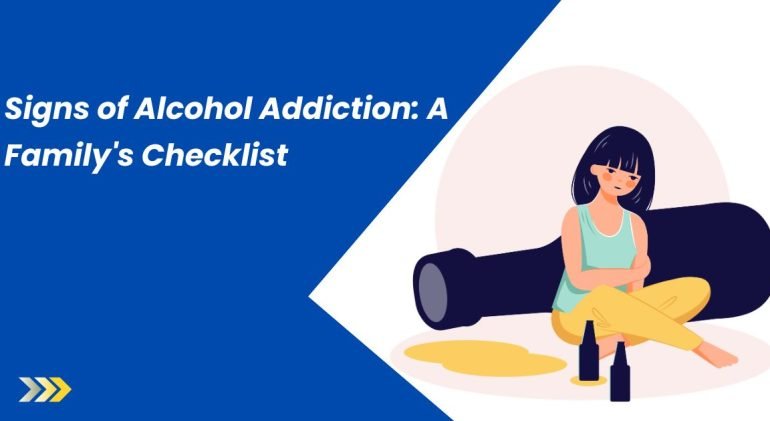
Signs of Alcohol Addiction: A Family’s Checklist
Table of Contents
You’ve noticed something’s off. Maybe it’s the empty bottles that keep showing up, the excuses for missed family events, or a mood that shifts the moment a drink enters the picture. You’re not imagining it — and you’re often the first person to notice, long before your loved one is ready to admit it themselves.
There’s no blood test or scan that confirms alcohol addiction. Instead, doctors and mental health professionals rely on recognizable patterns of behavior, physical changes, and emotional shifts (Michigan Medicine, 2025). This checklist is built around those same patterns, organized the way families actually experience them — through what they see, what they hear, and what they feel.
Key Takeaways
- Alcohol use disorder rarely announces itself — it shows up as a cluster of physical, behavioral, and emotional changes over time.
- Common signs include rising tolerance, withdrawal symptoms, secrecy around drinking, and neglect of work or family responsibilities.
- Family members are frequently the first to notice a problem, often before the individual recognizes it themselves (Bradford Health, 2023).
- Recognizing several signs together — not just one — is what usually points to a real problem worth addressing.
Physical Signs to Watch For
Physical changes are often the most visible, but families sometimes miss them because they build up slowly.
- Rising tolerance — needing noticeably more alcohol to feel the same effect as before
- Withdrawal symptoms — shakiness, sweating, nausea, irritability, or trouble sleeping when they haven’t had a drink in a while (IHS, 2025)
- Slurred speech, impaired coordination, or an unsteady walk, even outside of clearly intoxicated moments (Hanley Foundation, 2025)
- Changes in appearance — weight loss, poor hygiene, or a generally disheveled look as drinking takes priority over self-care (AddictionGroup, 2025)
- Facial redness, particularly around the nose and cheeks, or the smell of alcohol on breath or clothing that’s noticeable more days than not (Hanley Foundation, 2025)
<!– [UNIQUE INSIGHT] –> One pattern families often miss: it’s not the drinking itself that changes first — it’s the *recovery time*. Someone whose hangovers used to be a rough morning but who now needs most of a day to feel normal again is showing a real shift in how their body is processing alcohol, even if the amount they drink hasn’t changed much.
Behavioral Signs to Watch For
Behavior around drinking tends to shift before the drinking itself becomes obviously excessive.
- Drinking alone or hiding it — keeping bottles out of sight, timing drinks around when others aren’t home (IHS, 2025)
- Failed attempts to cut back — saying “I’ll stop” or “just one tonight” and repeatedly not following through
- Anger or defensiveness when questioned about their drinking, even in a gentle, caring way (IHS, 2025)
- Neglecting responsibilities — missed work, forgotten school pickups, chores or bills that used to get done on time
- Making every occasion about drinking — needing alcohol to enjoy a family function, or losing interest in events that don’t include it (Bradford Health, 2023)
- Risky behavior — driving after drinking, or getting into legal or financial trouble connected to alcohol (IHS, 2025)
[INTERNAL-LINK: understanding alcohol withdrawal → our alcohol withdrawal timeline and detox guide]
Social and Emotional Signs to Watch For

These signs are often the hardest to name, because they can look like ordinary stress or a rough patch — until you notice how consistent they’ve become.
- Isolation from family and friends, especially people who don’t drink or who’ve raised concerns before (IHS, 2025)
- Anxiety or irritability around alcohol-free gatherings — becoming visibly uncomfortable at events where drinking isn’t part of the plan
- Continuing to drink despite clear consequences — a health scare, a strained marriage, a warning at work — that would stop most people, but doesn’t change their drinking
- Mood swings or depression that track closely with drinking and not drinking
- A sudden change in friend groups or hangouts, often shifting toward people or places centered on drinking (IHS, 2025)
In our own intake conversations at AYYA Care Foundation, families most often describe this stage not as “the drinking got worse” but as “he stopped being himself” — the personality changes and withdrawal from the family are usually what finally push someone to reach out for help, even before the physical signs become undeniable.
How Many Signs Point to a Real Problem?
You don’t need every item on this checklist to be true for concern to be justified. Clinically, professionals look for a cluster of these signs occurring together over roughly a year — the standard diagnostic approach checks for the presence of at least two out of eleven recognized criteria, with more criteria present indicating greater severity (MedlinePlus, 2025; Michigan Medicine, 2025).
In practice, that means: one missed family dinner isn’t a red flag. But rising tolerance, secrecy, withdrawal symptoms, and pulling away from the family, showing up together and getting worse over months — that combination is worth taking seriously.
Alcohol use disorder is common, and it’s also commonly missed. National data shows roughly 17 million adults in the U.S. alone live with alcohol use disorder, yet the same NIAAA research notes that less than 10% of people with the condition ever receive treatment (Bradford Health, 2023; Michigan Medicine, 2025). Families are often the ones who close that gap — by noticing early and encouraging treatment before a crisis forces the issue.
[INTERNAL-LINK: what to expect on your first visit → our pre-admission assessment and family consultation process]
What to Do If You Recognize These Signs
Noticing these signs in someone you love is unsettling, but it’s also the first genuinely useful step toward helping them.
- Talk to them privately and calmly — not during or right after a drinking episode, and not in front of others
- Use specific examples, not accusations — “I noticed you seemed shaky this morning” lands differently than “you have a problem”
- Avoid ultimatums delivered in anger — they tend to trigger defensiveness rather than openness
- Involve a professional early — a counselor or treatment centre can guide the conversation and assess severity more objectively than family alone can
- Take care of yourself too — supporting someone through addiction is exhausting, and family counselling exists for your wellbeing as much as theirs
Frequently Asked Questions
What are the first signs of alcohol addiction?
Early signs often include rising tolerance (needing more to feel the same effect), drinking to cope with stress, and minor lapses in judgment or memory around drinking occasions (AddictionGroup, 2025). These early signs are frequently dismissed as normal social drinking until a clearer pattern emerges.
How can I tell if a family member is hiding their drinking?
Common signs include finding hidden bottles, drinking alone before or after social events, unexplained absences, and defensiveness or anger when their drinking is gently questioned (IHS, 2025).
Is it possible to have a mild drinking problem that isn’t full-blown addiction?
Yes. Alcohol use disorder exists on a spectrum from mild to severe, based on how many of the recognized diagnostic criteria are present (MedlinePlus, 2025). Mild cases can be harder to spot, especially in people who otherwise function well at work or socially.
Should I confront my loved one immediately if I notice these signs?
A calm, private conversation is generally more effective than a confrontation, especially if it happens outside a moment of active drinking. Involving a counselor or treatment professional early can help the conversation stay constructive rather than becoming a conflict.
When should withdrawal symptoms be treated as a medical emergency?
Severe withdrawal symptoms — including fever, seizures, or hallucinations — require immediate medical attention and should not be managed at home (MedlinePlus, 2025).
Moving Forward
Recognizing these signs doesn’t mean you have to have all the answers — it means you’ve noticed something worth acting on. Whether it’s one conversation or a full assessment with a treatment team, the earlier a family engages with the problem, the more options are available.
Key takeaways:
- Look for clusters of physical, behavioral, and emotional signs — not just one isolated moment
- Families are often the first to notice, and that early noticing matters
- A calm conversation and professional guidance work better than confrontation or ultimatums
If you’re recognizing several of these signs in someone you love, reach out to AYYA Care Foundation for a confidential family consultation].