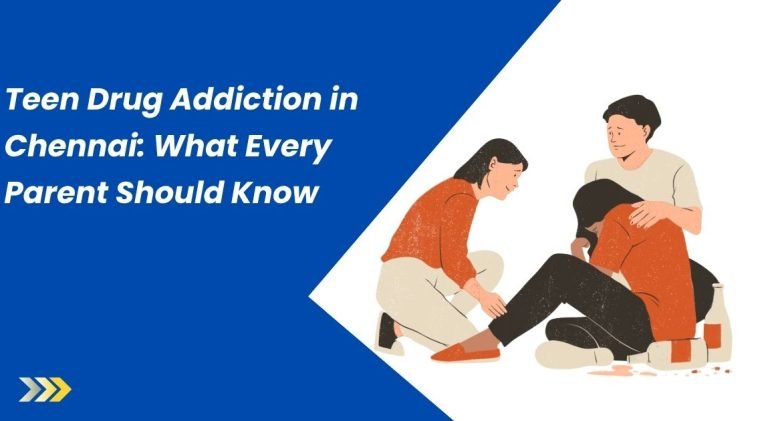
Teen Drug Addiction in Chennai: What Every Parent Should Know
Table of Contents
If you’re reading this because you’re worried about your teenager, you’re not alone — and you’re not overreacting. Teen substance use is far more common across Tamil Nadu than most parents realize, and the earlier it’s addressed, the easier recovery tends to be. This guide walks through what the research actually shows about teen drug use in Tamil Nadu, the warning signs worth taking seriously, how to start the conversation, and what treatment looks like when a teenager needs professional help.
Key Takeaways
- An estimated 1.5 crore (15 million) minors aged 10–17 use substances across India, and 34% of adolescents in Tamil Nadu specifically report having used some substance (International Journal of Community Medicine and Public Health, 2025).
- A government-run survey of adolescents in de-addiction treatment found 70% had started using drugs between ages 10 and 15, with tobacco and alcohol as the most common starting points before progressing to cannabis (Kathiresan & Gupta, SAGE Journals, 2025).
- The teenage brain’s reward system matures earlier than its impulse-control system, which is a key biological reason adolescents are more prone to risk-taking and substance experimentation than adults (Kathiresan & Gupta, SAGE Journals, 2025).
- A single unusual behavior rarely confirms drug use — it’s a cluster of changes lasting more than two weeks, across behavior, mood, and physical signs, that’s worth taking seriously (Partnership to End Addiction).
- Although this article focuses on drug use among teenagers, parents should also be aware of the signs of alcohol addiction, as alcohol misuse can sometimes occur alongside or separately from other substance use.
How Common Is This in Tamil Nadu, Really?
It’s more common than most families assume. A 2025 nationwide survey of school-going adolescents across 10 Indian cities found that 15.1% of students reported having used a substance at some point, 10.3% in the past year, and 7.2% in the past month — including tobacco (Dhawan et al., National Medical Journal of India, 2025, retrieved 2026-08-25).
The Tamil Nadu-specific picture is more striking: a 2025 review citing NFHS-5 and related data found that 34% of adolescents in Tamil Nadu report having used some substance (IJCMPH, 2025, retrieved 2026-08-25). A 2025 Times of India report cited in the same review found that one in every five high school students in Namakkal district uses tobacco (IJCMPH, 2025).
Research on Tamil Nadu college students specifically found alcohol, “cool lip” (a smokeless tobacco product), and regular tobacco to be the most commonly used substances, with curiosity and stress management cited as the two biggest reasons students said they started using (Substance Use Among Late Adolescents in Tamil Nadu, ResearchGate, 2025, retrieved 2026-08-25).
[Chart: bar chart showing substance use prevalence — national school survey (15.1% lifetime) vs Tamil Nadu adolescents (34% any substance) vs Namakkal tobacco-specific (1 in 5)]
Why Teenagers Are More Vulnerable Than Adults

This isn’t just about poor decision-making or bad influences — there’s real biology behind why adolescence is the highest-risk window for substance use to take hold. During adolescence, the brain’s emotional and reward-processing region (the limbic system) matures earlier than the frontal lobe, which governs impulse control and long-term judgment. That mismatch makes teenagers naturally more impulsive and more prone to risk-taking, including substance experimentation (Kathiresan & Gupta, SAGE Journals, 2025, retrieved 2026-08-25).
This is also why early exposure carries outsized long-term risk: research consistently shows that the earlier someone’s age of onset for substance use, the higher their risk of developing a full addiction to that substance later (Kathiresan & Gupta, SAGE Journals, 2025).
A government survey conducted by Kerala’s Excise Department among adolescents already in de-addiction treatment found that 70% had started using drugs between ages 10 and 15, and 9% had started between ages 5 and 10 — with tobacco and alcohol as the typical starting points, and cannabis use common among those seeking treatment (Kathiresan & Gupta, SAGE Journals, 2025). While this data is from Kerala rather than Tamil Nadu specifically, the pattern of early onset and progression is consistent with what’s seen across South India.
[EVIDENCE-BACKED EXPLANATION: This is exactly why waiting for a “big enough” reason to intervene often means intervening too late — the biological vulnerability is highest precisely during the years when substance use looks most like ordinary teenage exploration.]
Warning Signs Worth Paying Attention To
No single behavior confirms drug use on its own — many warning signs overlap with normal teenage development or with mental health struggles like anxiety and depression. What matters is a cluster of changes that persists for more than two weeks (Partnership to End Addiction, retrieved 2026-08-25).
Behavioral changes
- A sudden change in friend group, especially one your teen is secretive about
- Declining grades or noticeably less effort on schoolwork
- Increased secrecy — locked doors, defensiveness about their phone, evasiveness about their whereabouts
- Breaking curfews or rules that weren’t previously an issue
Emotional and psychological changes
- Mood swings, irritability, or seeming “not themselves” emotionally
- Increased anxiety or low mood that wasn’t there before
- Loss of interest in activities, sports, or friendships they used to care about
Physical signs
- Unusual smells on clothing or breath
- Bloodshot eyes, or patterns of unusual energy followed by lethargy
- Noticeable changes in sleep or appetite
- Missing money or unexplained new possessions
A pediatrician quoted in a recent parent-facing guide put it plainly: “Don’t chalk it up to just being teenagers. It’s always easy to do that, but any behavioral changes you are noticing means there’s something else going on” (Sutter Health, retrieved 2026-08-25).
How to Start the Conversation

The instinct to lecture or confront is understandable, but research consistently shows it backfires. A calm, non-accusatory approach gets further than an ultimatum.
- Choose the right moment. Wait until both of you are calm and your teen is sober — not mid-argument, not right after an incident (Mayo Clinic, retrieved 2026-08-25).
- Lead with concern, not accusation. Frame it as a specific observation — “I’ve noticed you’ve seemed really tired and your mood has changed, and I’m worried” — rather than a character judgment (Countrywide Testing, 2026, retrieved 2026-08-25).
- Ask more than you tell. Open-ended questions like “can you tell me what’s going on in your life right now?” work better than lectures — and listening matters more than talking in this first conversation (Countrywide Testing, 2026).
- Avoid scare tactics. Focus on what substance use could affect that your teen actually cares about — sports, driving, friendships, appearance — rather than generic warnings (Mayo Clinic).
- Make it an ongoing conversation, not a one-time event. Risk factors shift throughout adolescence, so checking in regularly matters more than a single “big talk” (Child Mind Institute, retrieved 2026-08-25).
- Address the underlying pain, not just the behavior. If a teen is using substances to cope with stress, anxiety, or emotional pain, that pain doesn’t disappear just because they promise to stop — professional support for the underlying issue matters as much as addressing the substance use itself (Sutter Health).
- Professional treatment may include therapies that help teenagers understand their thoughts, emotions, and behaviors, and learning what CBT for addiction recovery is can help parents better understand one of the approaches used during treatment.
What Treatment Looks Like for Teenagers

Teen addiction treatment is not simply adult treatment scaled down — adolescents need an approach built around their developmental stage, their family system, and often a co-occurring mental health concern like anxiety or depression that’s part of what drove the substance use in the first place.
At Ayya Care Foundation, treatment for adolescents typically includes a clinical assessment to understand what’s driving the substance use, age-appropriate individual and family therapy, and close family involvement throughout — since a teenager’s recovery is rarely separate from what’s happening at home and school. Because early-onset use is linked to higher long-term addiction risk, addressing it early — rather than waiting to see if a teen “grows out of it” — meaningfully improves outcomes.
Frequently Asked Questions
At what age do most teens in India start using substances?
Research on adolescents in de-addiction treatment found 70% had started using drugs between ages 10 and 15, with tobacco and alcohol as the most common substances used first (Kathiresan & Gupta, SAGE Journals, 2025).
Is it normal for teenagers to experiment, or is any use a red flag?
Experimentation — trying a substance once or a few times out of curiosity, usually socially, without major life disruption — is different from a developing pattern of use. The distinguishing factor is whether it’s an isolated event or part of a cluster of behavioral, emotional, and physical changes lasting more than two weeks (Partnership to End Addiction).
Should I drug test my teenager at home if I’m suspicious?
Home drug testing isn’t generally recommended without medical guidance. If you’re concerned enough to consider it, that level of concern is a signal to consult a pediatrician, doctor, or addiction specialist rather than testing on your own first (Sutter Health).
What if my teen promises to quit on their own?
Even a genuine promise to stop doesn’t address why the substance use started in the first place. If a teen was using drugs or alcohol to cope with stress, anxiety, or other pain, that underlying issue needs its own support — otherwise the risk of returning to substance use remains high (Sutter Health).
This article is for informational purposes and is not a substitute for a professional clinical assessment. If you’re concerned about a teenager’s substance use, Ayya Care Foundation’s clinical team is available for a confidential consultation.